
Rosemary
Ingredient
Rosemary
Benefits:NaturalPlant
“Dew of the sea” to the Romans — a Mediterranean shrub that flowers in winter and smells of pine, camphor and lemon all at once.
What is rosemary?
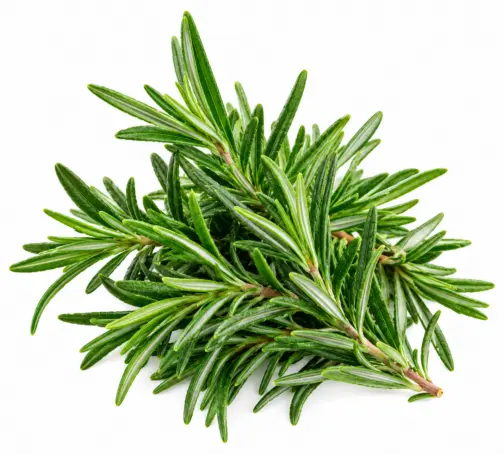
Rosemary (Rosmarinus officinalis, now Salvia rosmarinus) is an evergreen shrub of the mint family, a relative of lavender, thyme and sage. Its needle-like leaves are full of glands holding essential oil, which is obtained by steam distillation. Depending on origin, the oil is rich in 1,8-cineole, camphor or verbenone, with alpha-pinene and borneol. The leaves also contain carnosic acid and rosmarinic acid, two of the most powerful plant antioxidants — which is why rosemary extract is also used as a natural preservative for oils.
What are the benefits of rosemary?
No other herb is so closely tied to hair care. Applied topically it:
- Has a toning, invigorating action
- Activates surface circulation of the scalp
- Offers carnosic and rosmarinic acid with antioxidant activity
- Has a slightly astringent feel, suited to an oily scalp
- Scents with a clean, herbal, slightly camphorous note
The herb of remembrance
Ancient Greek students wore rosemary garlands while studying, believing it strengthened memory — and Shakespeare’s Ophelia offers it “for remembrance”. “Hungary Water”, a 14th-century rosemary distillate, is considered Europe’s first alcohol-based perfume. It has never been absent from Mediterranean cooking or from traditional hair care, where a rosemary rinse was used for dark, glossy hair.
Where does it come from?
Rosemary is native to the Mediterranean and grows wild on rocky coastal slopes — hence the Latin ros marinus, “dew of the sea”. The main producers of the essential oil are Tunisia, Morocco and Spain; in Greece it thrives everywhere, from Crete to Halkidiki.
Products with rosemary
All our products that contain it, from their ingredient lists.
Showing the single result

Showing the single result